
Cognitive Exam Outline
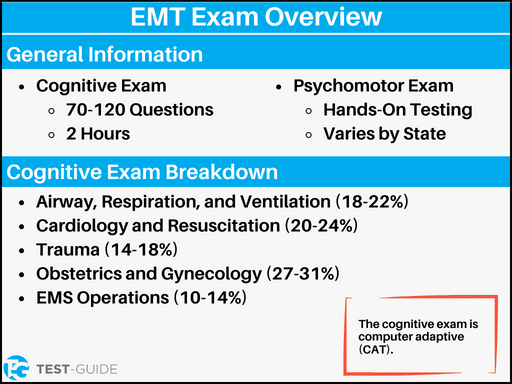
The cognitive exam consists of multiple-choice questions. The exam is a computer adaptive test, which means the questions get harder or easier depending on how you answered the previous question.
The questions will cover 5 different categories. Each of the categories (except EMS Operations) will be further split into Adult (85%) and Pediatric (15%) questions.
- Airway, Respiration, & Ventilation (18-22%)
- Cardiology & Resuscitation (20-24%)
- Trauma (14-18%)
- Medical; Obstetrics & Gynecology (27-31%)
- EMS Operations (10-14%)
For more information, visit the official website.
Psychomotor Exam Outline
The psychomotor exam consists of you performing various emergency medical skills in front of an instructor.
At the EMT level, the psychomotor exam is administered by the state EMS office or by an educational institution approved by the state.
With this being the case, the psychomotor exam will vary from state to state. Some concepts you should be familiar with include:
- Patient Assessment
- Patient Management
- BVM Ventilation
- Oxygen Administration
- Spinal Immobilization (Supine and Seated)
- Bleeding Control
- Shock Management
- Cardiac Arrest/AED
- Joint Immobilization
- Long Bone Immobilization
EMT Exam Eligibility
Before you can sit for the EMT exam, you will need to meet the following requirements:
- Completion of a state-approved EMT program.
- Have your CPR-BLS for Healthcare Provider certification.
EMT Exam Registration
You can follow these steps to register for your EMT test:
- Complete the requirements listed above (state-approved program and CPR-BLS certified).
- Create an account on the NREMT website.
- Wait for your application to be reviewed.
- Pay your application fee ($98).
- Receive your Authorization to Test (ATT).
- Schedule your exam. You will have 90 days to schedule once you receive your ATT.
For more information, you can review the official EMT candidate handbook. We recommend answering some of the NREMT practice questions above before registering for your exam.
Scoring of the EMT Exam
Since the exam is computer adaptive, the scoring of the exam is not as straight-forward as you would think.
Not all students receive the same number of questions. The questions are weighted, with the harder questions being worth more points.